25 ESL Games for the Classroom: No-Prep Ideas

25 ESL Games for the Classroom: No-Prep Ideas
Every ESL teacher in China knows the moment. Your lesson plan runs out ten minutes early, or the activity you planned falls flat, and forty pairs of eyes are suddenly all on you. That's when a good game saves the lesson — and the best ESL games need nothing but a board, your voice, and a class that wants to play.
These 25 ESL games are all no-prep: no printing, no cards to cut, no materials to buy. Pick one, read the steps, and play it today. Still looking for a classroom? Browse English teaching jobs in China.
The short answer: the best no-prep ESL games are Hangman, Hot Seat, Word Tennis, Two Truths and a Lie, and Simon Says. They need zero materials, work for any class size, and get every student speaking within a minute. Below are 25 of them — warmers, vocabulary, speaking, and review games — each with steps and a variation.
Warm-Up ESL Games
1. Simon Says
Practises: listening, body parts · Class size: any · Prep: none.
Give commands: "Simon says touch your nose." Students only follow commands starting with "Simon says."
Anyone who moves on a plain command sits down. Last student standing wins.
Variation: use this week's words — "Simon says point at the window."
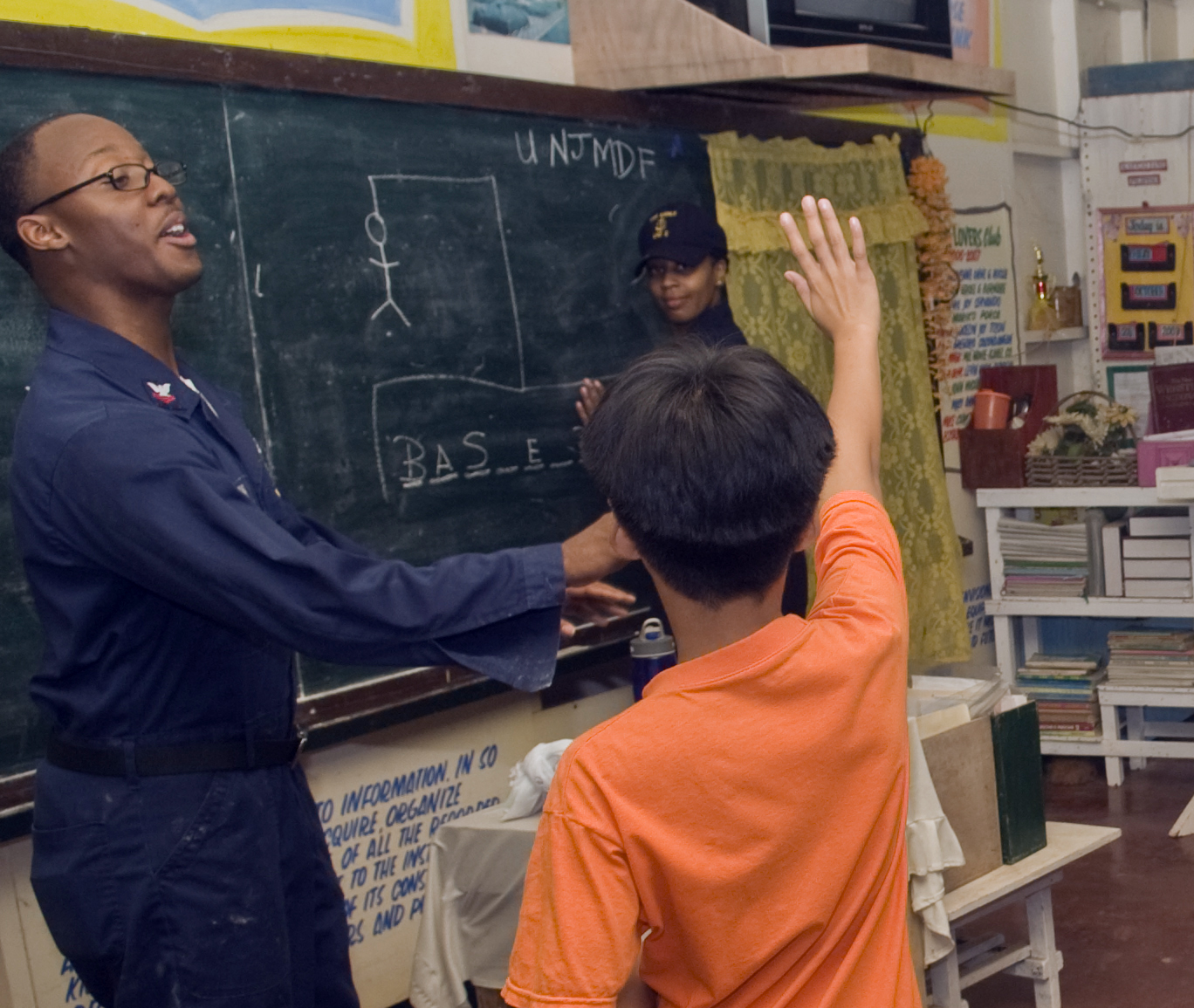
2. Hangman
Practises: spelling, vocabulary · Class size: any · Prep: a board.
Pick a word from this week's lesson and draw a blank for each letter.
Students call out letters. A right letter fills a blank; a wrong letter adds a body part. The class wins if they guess the word before the drawing is finished.
Variation: let a strong student be the hangman.
3. Word Chain
Practises: vocabulary recall, spelling · Class size: any · Prep: none.
Say a word, for example "apple." The next student says a word starting with the last letter: "elephant."
A repeat or a five-second freeze, and you're out.
Variation: set a category — animals only, food only.
4. Two Truths and a Lie
Practises: speaking, past tense · Class size: any · Prep: none.
A student says three sentences about themselves: two true, one false.
The class asks one question each, then votes on the lie. The student earns a point for every classmate they fooled.
Variation: the teacher goes first, with one lie about life in China.
5. Pictionary
Practises: vocabulary, describing · Class size: any, in teams · Prep: a board.
One student comes to the board. Whisper them a word — they draw it, no letters, no talking.
Their team has 30 seconds to guess. A correct guess scores a point.
Variation: ban the obvious drawing — no drawing the cat itself.
Vocabulary ESL Games
Want vocabulary games matched to the words beginners learn first — body parts, classroom objects, family and toys? See our 12 ESL vocabulary games.
6. Hot Seat
Practises: vocabulary, paraphrasing · Class size: any, in teams · Prep: a board.
One student sits with their back to the board. Write a word behind them.
Their team describes the word without saying it. "It's an animal. It says meow." A correct guess in 30 seconds scores a point, then swap seats.
Variation: forbid the three most obvious clue words.
7. Word Tennis
Practises: vocabulary speed, categories · Class size: pairs or two teams · Prep: none.
Two students face each other. You call a category: "food."
They take turns saying a word in the category, back and forth. A repeat, a wrong word, or a pause over three seconds loses the rally.
Variation: play it as a whole-class rally in a circle.
8. A–Z Race
Practises: vocabulary breadth, spelling · Class size: teams · Prep: a board.
Give each team a category: animals, jobs, things in a classroom.
Teams race to write one word for each letter, A to Z. First team to finish with no repeats wins — but check every word.
Variation: allow only words from this unit's word list.
9. Kim's Game
Practises: memory, vocabulary · Class size: any · Prep: a board.
Write ten words from this week's lesson on the board. Give the class 30 seconds to memorise them.
Erase one word — or the whole list — and ask what was there. Full marks for a complete list, in any order.
Variation: erase the list and make students rebuild it from memory, one word each.
10. Odd One Out
Practises: vocabulary, reasoning · Class size: any · Prep: a board.
Write four words on the board: "apple, banana, car, orange."
Students say which word doesn't belong — and why, in a full sentence. Accept any answer with a good reason.
Variation: let students write the sets.
11. Categories
Practises: vocabulary, quick thinking · Class size: any · Prep: a board.
Write three headings on the board: "food," "animals," "jobs." Call out a letter.
Teams race to write one word per category starting with that letter. One point per word, two if no other team wrote it.
Variation: add a fourth column: "something in this classroom."
12. 20 Questions
Practises: question forms, vocabulary · Class size: any · Prep: none.
Think of a person, an animal, or an object. The class asks yes/no questions to find out what it is.
Answer only "yes" or "no." If the class guesses in 20 questions or fewer, they win. If not, you win.
Variation: a student thinks of the word, and the class questions them.
Speaking ESL Games
13. Telephone
Practises: listening, pronunciation · Class size: any, in lines · Prep: none.
Put students in lines of eight or ten. Whisper a sentence to the first student in each line.
Each student whispers it to the next. The last student says it out loud — the line closest to the original wins.
Variation: use a tongue-twister from the textbook.
14. Alibi
Practises: past tense, improvisation · Class size: 6 or more · Prep: none.
Two students leave the room. The class invents a "crime" — someone stole the teacher's lunch.
The two students come back separately and each tells the class where they were at lunchtime. The class asks questions and votes: do their stories match?
Variation: give the pair two minutes to agree their story first.
15. Would You Rather
Practises: speaking, opinions · Class size: any · Prep: none.
Ask a "would you rather" question: "Would you rather speak Chinese fluently or fly?"
Students pick a side — left of the room for one answer, right for the other. Ask two or three to explain their choice in one sentence.
Variation: students write the questions.
16. Word Association
Practises: vocabulary connections, fluency · Class size: any, in a circle · Prep: none.
Say a word: "school." The next student says the first word it makes them think of: "teacher."
Go around the circle, one word each, as fast as you can. A pause over three seconds, or a word with no connection, and you're out.
Variation: ask students to explain their strangest connection.
17. Charades
Practises: vocabulary, describing actions · Class size: any, in teams · Prep: none.
One student mimes a verb — swimming, cooking, sleeping — without speaking.
Their team guesses the action. One minute, one point per correct guess. Rotate the actor so everyone gets a turn.
Variation: mime a job instead of an action.
18. Story Chain
Practises: speaking, past tense · Class size: any, in a circle · Prep: none.
Start a story with one sentence: "Yesterday I found a red envelope on the street."
Each student adds one sentence. If a student can't continue in five seconds, they sit out. The last student standing finishes the story.
Variation: set the story in your city.
19. Interview Swap
Practises: question forms, listening · Class size: pairs · Prep: none.
Students pair up and interview each other for two minutes: name, hometown, favourite food, one surprising fact.
Then each student introduces their partner to the class — not themselves. The class votes for the most surprising fact.
Variation: ban the three easy questions (name, age, hometown).
Review and Filler ESL Games
20. Countdown
Practises: numbers, quick thinking · Class size: any · Prep: a board.
Write a target number on the board, for example 24, and four small numbers: 3, 5, 2, 8.
Teams have one minute to reach the target using addition, subtraction, multiplication, or division. First team with a correct working scores.
Variation: use numbers from the lesson — dates, prices, ages.
21. Word Ladder
Practises: spelling, vocabulary · Class size: any · Prep: a board.
Write a word on the board: "cat." The class changes one letter to make a new word: "bat."
Keep changing one letter at a time — bat, bet, bed. Challenge teams to reach a target word in as few steps as possible.
Variation: start with a word from this week's vocabulary and end with another.
22. Rhyming Chain
Practises: phonics, listening · Class size: any · Prep: none.
Say a word: "day." The next student says a rhyming word: "play."
Keep going around the class. A word that doesn't rhyme, or a repeat, and you're out. When the chain breaks, start a new word.
Variation: for older students, ban one-syllable rhymes.
23. Guess Who
Practises: describing people, adjectives · Class size: any · Prep: none.
Think of a student — don't say who. Describe them in three clues: "wearing blue, sits near the window."
The class guesses. The first correct guess wins, and that student describes the next person. Keep clues kind — clothes, seats, habits.
Variation: describe a famous person or a teacher from another class.
24. Memory Chain
Practises: vocabulary, memory, lists · Class size: any, in a circle · Prep: none.
Start the chain: "I went to the market and I bought an apple."
The next student repeats the list and adds one item: "…and some rice." The chain grows until someone forgets an item.
Variation: change the sentence to match your unit.
25. The Yes/No Game
Practises: question forms, quick thinking · Class size: pairs or whole class · Prep: none.
One student stands at the front. The class asks questions — but the student may only answer "yes" or "no."
If the student says any other word — "maybe," "I don't know," a laugh that turns into a word — they're out. The longest survivor wins.
Variation: the class must ask only questions about the lesson topic.
Want It Ready-Made?
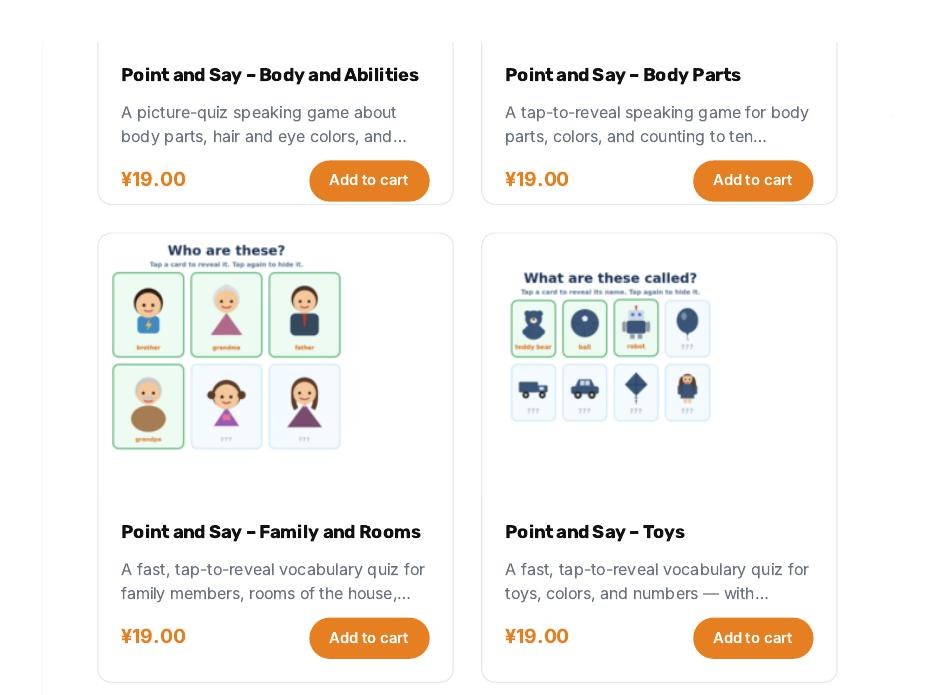
Free games are great, but some days you want something polished that runs itself. Our own games are made by ESL teachers, for ESL teachers, and run straight off the smartboard.
Point and Say – Classroom Objects — a fast vocabulary quiz for classroom objects, colours, and numbers. ¥19 (about $2.60). Get it here
Point and Say – Toys — the same tap-to-reveal quiz, for toys. ¥19 (about $2.60). Get it here
Point and Say – Family and Rooms — family members and rooms of the house. ¥19 (about $2.60). Get it here
Point and Say – Body Parts — body parts, colours, and counting to ten. ¥19 (about $2.60). Get it here
Point and Say – Body and Abilities — body parts, hair and eye colours, and abilities. ¥19 (about $2.60). Get it here
Closet Clash — dress a cartoon character and race to describe the outfit. ¥29 (about $4.00). Get it here
Pick the one that matches this week's vocabulary and play it as a warmer. And if you're still looking for a classroom, our guide to English teaching jobs in China: pay, visas and how to apply is the place to start.
Pro Tips
Teach the game before you play it. Demonstrate one round with your best student while the class watches. Rules explained are forgotten; rules seen are remembered.
Keep score on the board, always. Even a simple tally of Team A vs Team B turns a quiet drill into a competition students care about.
Cap a game at ten minutes. Games are seasoning, not the meal. When the energy peaks, stop — ending on a high note means they'll beg to play it again.
When a game flops, drop it fast. Demonstrate one round yourself; if it still doesn't work, switch to a game you know lands. A failed game isn't a failed lesson.
Keep a "rainy day" list. Write your five favourite games on a card and keep it in your bag. The day your slides won't load, you'll be glad you did.
New to the job? See what English teachers in China really earn.
More ideas: Bridge's TEFL blog has a good list of ten no-prep ESL activities for the last ten minutes of class.
You've Got This
Here's the secret nobody tells new teachers: the games aren't really about the games. They're about the moment a shy student forgets to be nervous because they're too busy trying to win.
So pick one game from this list and try it in your very next class. And if you're still looking for that classroom, browse English teaching jobs in China — your class is out there waiting.
FAQ
What are the best ESL games for beginners?
Hangman, Simon Says, and Pictionary. They need almost no English to understand, they work with any class size, and they drill the vocabulary beginners need most. Start with these, then add Hot Seat and Word Tennis once students have more words.
How do I play ESL games with a large class of 40 or more students?
Play in teams, not individuals. Split the class into four or five teams and let the captains come to the front. Team games keep forty students engaged — and you only manage five captains at once.
What if my students are too shy to speak during games?
Start with games where speaking is low-risk, like Hangman or Word Chain, where a student only says one word. Never force a shy student to perform alone in front of the class. Let them answer in pairs first, then in small groups.
Do I need to buy materials for ESL classroom games?
No. Every game in this list needs nothing but a board and your voice — that's the whole point. If you want a polished, ready-made game that runs off the smartboard, our Point and Say games cost ¥19 (about $2.60) each and Closet Clash costs ¥29 (about $4.00) at games.youteacher.org.
Where can I find more ESL games for my classroom?
Start with the 25 games above — they'll cover a whole term of warmers and fillers. For more, Bridge's TEFL blog has a solid list of no-prep activities, and our own games shop has six ready-made smartboard games. New to teaching here? Start with our guide to English teaching jobs in China.
Photo: U.S. Navy photo by Mass Communication Specialist 3rd Class Gabriel S. Weber (public domain), via Wikimedia Commons.