ESL Vocabulary Games: Body Parts, Objects, Family & Toys

ESL Vocabulary Games: Body Parts, Objects, Family & Toys
Young learners don't learn vocabulary from a word list. They learn it by shouting it, touching it, grabbing it and laughing at it. That's why ESL vocabulary games work so well with the words beginners meet first: body parts, classroom objects, family members and toys. These are words you can point at, hold up and act out — no translation needed.
Below are 12 free ESL vocabulary games — three for each topic — with what each practises, the class size, the prep time, numbered steps and one variation. Most need nothing you don't already have in the room. Still looking for a classroom of your own? Browse English teaching jobs in China.
The short answer: the best ESL vocabulary games for young learners are Flyswatter, Memory Match, What's Missing?, Family Bingo and Toy Shop. They need almost no preparation, work with classes of 40 or more, and drill the words beginners meet first. Below are 12 of them — three per topic — with steps and a variation for every game.
ESL Vocabulary Games for Body Parts
Body parts are the easiest vocabulary to teach, because every student is wearing the flashcards. Start with nine words: arms, ears, eyes, legs, hair, hands, feet, mouth and nose — the same set in National Geographic Learning's Our World Starter, Unit 4.
1. Flyswatter
Practises: listening, word recognition · Class size: any · Prep: 5 minutes (two flyswatters, or rolled-up newspapers)
Write the nine body-part words on the board, spread out in a random order.
Split the class into two teams. One player from each team stands at the board with a flyswatter.
Call out a word — or describe it: "the thing you smell with", "you have two of these".
The first player to swat the right word wins a point. Swap players every round.
Variation: use pictures instead of words. Pre-readers can play the same game without needing to read anything.
2. Label the Body
Practises: spelling, labelling · Class size: small groups · Prep: 10 minutes (a big sheet of paper per group)
Draw a big body outline on the paper — or trace around a volunteer lying on it.
Give each group the same outline and a set of body-part word cards.
Groups take turns sticking one label in the right place and reading it aloud: "This is the nose."
A correct label scores a point. A wrong one goes back in the pile.
Variation: make it a race — 60 seconds to label as many parts as possible.
3. Head, Shoulders, Knees and Toes
Practises: listening, movement · Class size: any · Prep: none
Sing the song slowly, touching each body part as you name it: head, shoulders, knees, toes, eyes, ears, mouth, nose.
Sing it again, a little faster. Then again, faster still.
On the fourth round, drop one word — mime it silently and let the students shout the missing word.
Keep dropping words until the class is singing the whole song in mime.
Variation: swap in new words once the class knows the song — elbows, chin, eyebrows. The tune stays the same, the vocabulary grows.
ESL Vocabulary Games for Classroom Objects
Classroom objects are the second set every beginner meets: book, pencil, chair, eraser, crayon, paper, pen and desk. Every one of them is already in the room, so these games need no printing and no props beyond what you can grab off a desk.
4. What's Missing?
Practises: memory, naming · Class size: any · Prep: 2 minutes (gather 6–8 classroom objects)
Line the objects up on a desk where everyone can see them.
Give the class 30 seconds to memorise the line-up.
Students close their eyes. Take one object away and hide it behind your back.
"Open your eyes. What's missing?" The first correct answer in a full sentence ("The pencil is missing.") scores a point.
Put the object back, add a new one, and play again.
Variation: take two objects away at once, or swap the positions of two objects and ask "What changed?"
5. Memory Match
Practises: reading, matching · Class size: pairs or small groups · Prep: 10 minutes (word cards and picture cards for the eight classroom objects)
Lay the word cards and picture cards face down in a grid on the desk.
A student flips over two cards. If the word matches the picture — "pencil" with the pencil — they keep the pair.
To keep a pair, the student must say the word in a full sentence: "It's a pencil."
A miss means both cards go back face down, and the next player goes.
Variation: play it as a race — two teams, two grids, first team to match all eight pairs wins.
6. Hot Potato
Practises: quick recall under pressure · Class size: a circle · Prep: 1 minute (any soft object — a pencil case works)
Students sit in a circle. Start some music, or count out loud — the "potato" gets passed from hand to hand.
When the music stops, the student holding the potato is on the spot.
Hold up a classroom object or a flashcard. The student names it in a full sentence: "It's a crayon."
A correct answer keeps them in the game. A wrong one costs them a turn.
Variation: instead of naming the object, the student must answer a question about it: "What colour is it?" or "How many pencils can you see?"
ESL Vocabulary Games for Family
Family words — grandpa, grandma, father, mother, brother, sister — plus the rooms of the house (kitchen, bathroom, bedroom, living room) are the third set beginners meet. They're personal, which makes them easy to remember: every student has a family to talk about.
7. Family Bingo
Practises: listening, family words · Class size: any · Prep: 10 minutes (a bingo grid per student, with family words or pictures in the squares)
Hand out the grids. Each one has nine squares with a different family word or picture.
Call out a word: "Grandmother!" Students cover that square if they have it.
The first student to cover a full row shouts "Bingo!" — then reads the whole row aloud to claim the win.
Check the row together. A wrong call means the game carries on.
Variation: don't name the word — describe it instead. "Your mother's mother" means grandmother. Students have to work out who you mean before they can cover the square.
8. Who Am I?
Practises: Yes/No questions · Class size: pairs · Prep: 5 minutes (family word cards or sticky notes)
Stick a family word on each student's forehead — or tape it to their back. They can't see their own word.
Students ask each other Yes/No questions to work out who they are: "Am I a man?" "Am I older than you?" "Am I your mother's mother?"
They can only ask Yes/No questions — no guessing the word directly until they're sure.
The first student to guess correctly wins the round.
Variation: play it as a whole-class game. One volunteer stands at the front with a word on their forehead, and the class asks the questions together.
9. My Family Role-Play
Practises: speaking in full sentences · Class size: groups of 4–6 · Prep: none
Each group draws a family: grandpa, grandma, father, mother, brother, sister.
Every student takes a role and introduces themselves in character: "Hello! I'm Grandpa. I'm in the living room."
Groups add one more sentence each: "I like my family." "My brother is funny."
Each group performs its family introductions for the class.
Variation: add the rooms. Each family member says where they are: "Mother is in the kitchen." "Brother is in the bedroom."
ESL Vocabulary Games for Toys
Toys are the vocabulary set students care about most: ball, balloon, car, doll, kite, robot, teddy bear and truck. Bring a few real toys to class and the games practically run themselves — the students will fight over who gets to hold the robot.
10. What's in the Box?
Practises: describing, guessing · Class size: any · Prep: 5 minutes (a box and 6–8 small toys)
Hide a toy inside the box where nobody can see it.
A volunteer reaches in and feels the toy — no peeking.
They describe it to the class: "It's soft. It's round. It has four wheels." No naming it.
The class guesses. The first correct guess wins a point, and the guesser goes next.
Variation: only Yes/No questions allowed. "Is it a car?" "Is it soft?" The class has ten questions to work it out.
11. Toy Shop
Practises: asking questions, polite phrases · Class size: pairs or small groups · Prep: 5 minutes (toys and paper price tags — play money optional)
Set up a "shop" on a desk: a ball, a car, a doll, a kite, a robot, a teddy bear, a truck — each with a price tag.
One student is the shopkeeper, the other is the customer. The customer asks: "How much is the teddy bear?"
The shopkeeper answers: "It's ¥10." The customer decides: "I'll take it!" or "Too expensive!"
Swap roles after three turns, so everyone gets to be the shopkeeper.
Variation: add colours and numbers. "The red car is ¥10." "I want two blue balloons, please."
12. Toy Sorting Race
Practises: categorising, naming · Class size: teams · Prep: 5 minutes (a pile of mixed toys, or toy picture cards)
Dump the toys in a pile in the middle of the room.
Teams race to sort them — by colour, by size, or by type — naming each toy as they place it: "A blue car!" "A big teddy bear!"
A toy only counts if the student names it correctly as they put it down.
The first team to sort its pile correctly wins the round.
Variation: sort by first letter. "B is for ball and balloon. C is for car." The team that names the most words for one letter wins.
Want It Ready-Made?
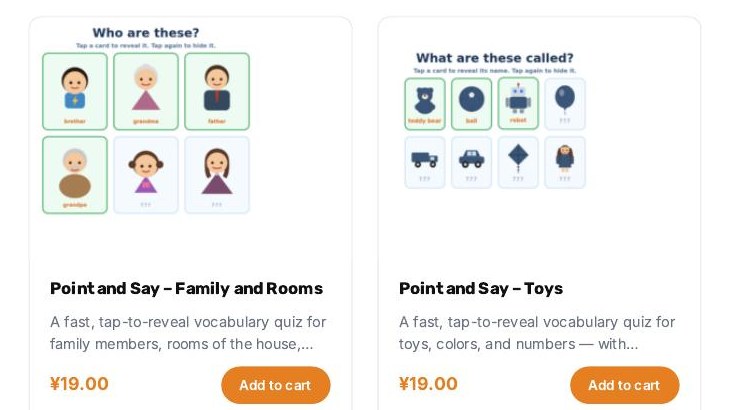
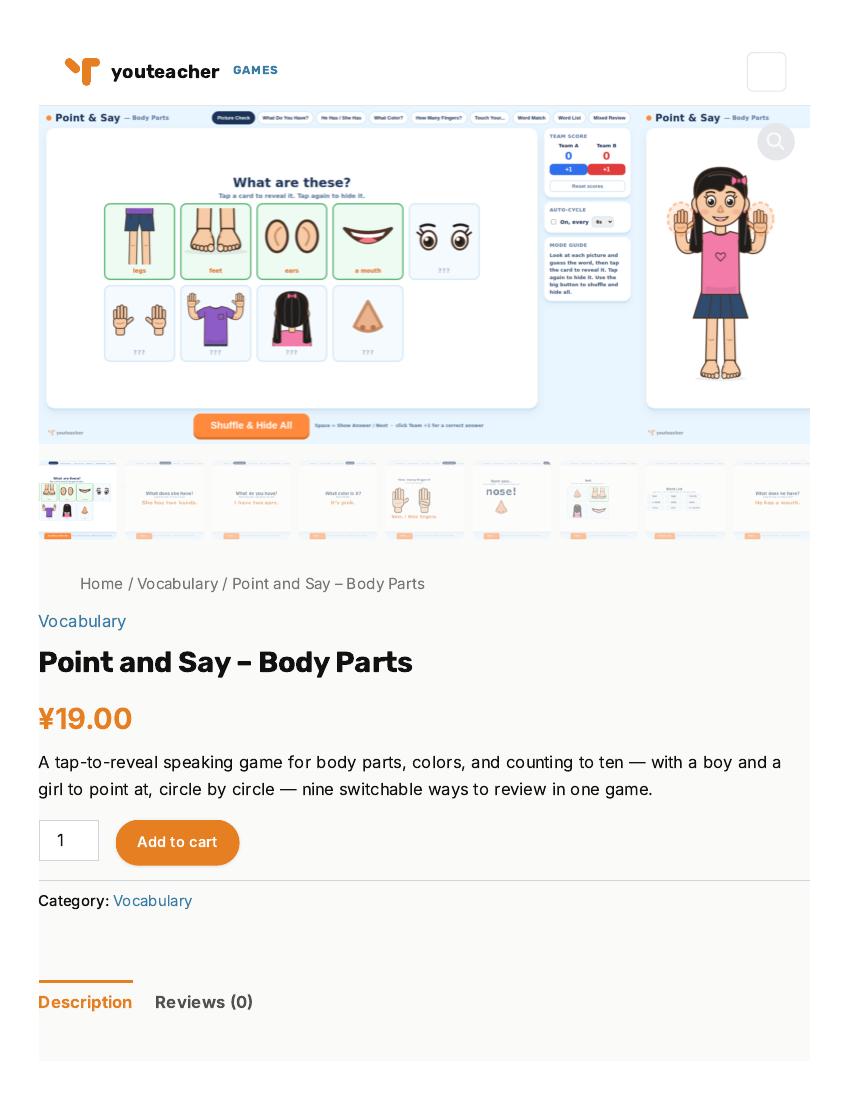
All 12 games above are free, and they work with nothing but the objects in your classroom. But if you want the same vocabulary on your smartboard — with pictures, sounds and scoring built in — our own Point and Say games cover exactly these four sets, one game per topic:
Point and Say – Classroom Objects — book, pencil, chair, eraser, crayon, paper, pen, desk; six quiz modes. ¥19 (about $2.60).
Point and Say – Toys — ball, balloon, car, doll, kite, robot, teddy bear, truck; eight modes, including a Yes/No pattern. ¥19 (about $2.60).
Point and Say – Family and Rooms — grandpa, grandma, father, mother, brother, sister, plus kitchen, bathroom, bedroom and living room; ten modes. ¥19 (about $2.60).
Point and Say – Body Parts — arms, ears, eyes, legs, hair, hands, feet, mouth and nose; nine modes, including a touch-and-move round. ¥19 (about $2.60).
All four together cost ¥76 (about $10.40) — less than one takeaway dinner — and they run offline in any browser on Windows or Mac, so dead classroom Wi-Fi can't kill your lesson. They also line up with National Geographic Learning's Our World Starter, Units 1–4. These are YouTeacher's own games, made by teachers who got tired of cutting out flashcards at midnight.
Pro Tips
Teach the words before you play. A quick two-minute Picture Check — hold up each word, say it together, then hide it and ask — means the game practises vocabulary instead of guessing.
Full sentences, always. "Pencil" is a word. "It's a pencil" is English. Insist on the sentence from the first round and it becomes a habit by the third.
One new rule at a time. If the game has a twist — teams, points, a timer — add it in round two, not round one. Confused students stop speaking.
Let the strong students teach. Put a confident student in charge of calling the words or running the timer. They practise more, and you get to watch the quiet ones.
End on a win. Finish with a game the class already knows and loves, so the lesson ends with everyone shouting the right answer.
Before You Go
Vocabulary sticks when students use it with their hands, their voices and each other — not when they stare at it. Pick one game from each section above, try it this week, and watch which words your students still remember on Friday. That's the game to play again next week.
If you haven't found your classroom yet, the jobs are out there waiting: browse English teaching jobs in China. And if you want more no-prep ideas for the days your plan runs out early, our 25 ESL games for the classroom cover warmers, speaking and review games with the same zero-prep rule. You've got this — and your students will love you for it.
New to teaching in China? Start with our guide to English teaching jobs in China: pay, visas and how to apply.
Wondering what the job pays? Here's what English teachers really earn in China.
FAQ
What are the best ESL vocabulary games for young learners?
Flyswatter, Memory Match, What's Missing?, Family Bingo and Toy Shop. They need almost no preparation, work with big classes, and drill the words beginners meet first. All five are in this post, with steps and a variation for each.
How do I teach body parts vocabulary to ESL beginners?
Start with the nine words students can point to on themselves: arms, ears, eyes, legs, hair, hands, feet, mouth and nose. Teach them with movement — touch each part as you say it — then play Flyswatter or Head, Shoulders, Knees and Toes so students hear and say each word many times in one lesson.
What classroom objects should ESL beginners learn first?
Book, pencil, chair, eraser, crayon, paper, pen and desk — the eight objects in every classroom. Teach them by pointing at the real thing, then play What's Missing? or Memory Match so students have to name each object from memory.
How can I make vocabulary games work with 40 or more students?
Use team games, not one-student-at-a-time games. Flyswatter, Family Bingo and Toy Sorting Race all keep the whole class playing at once, and the quiet students still get turns because the team needs every player. For more big-class ideas, see our 25 ESL games for the classroom.
Do I need to buy materials to play ESL vocabulary games?
No. All 12 games in this post use things already in the room — classroom objects, a box, some paper — or nothing at all. If you want the same vocabulary as a ready-made smartboard game, our Point and Say games cost ¥19 (about $2.60) each, and all four sets together are ¥76 (about $10.40).
Hero photo: wooden alphabet blocks by Bobjgalindo, CC BY 4.0, via Wikimedia Commons.