English Teacher Salary in China: What You'll Really Earn

English Teacher Salary in China: What You'll Really Earn
So you're thinking about teaching English in China, and the first question is the obvious one: how much will I actually make? The good news is that most foreign English teachers earn enough to live comfortably, eat out most nights, travel on the holidays, and still save. But the range is wide, and the number on the offer letter is only half the story — housing, flights, insurance, and a completion bonus can be worth as much as the salary itself.
The short answer: Most first-year foreign English teachers in China earn ¥10,000–¥25,000 a month (about $1,400–$3,500 at roughly ¥7.2 to the dollar), with free housing or a housing allowance on top. Licensed teachers at international schools can reach ¥25,000–¥45,000 (about $3,500–$6,250). Your exact pay depends on the school type, the city, and your qualifications — and the full package, not just the monthly number, is what you should compare.
English Teacher Salary in China by School Type
Every 2026 salary guide agrees on the shape of the market, even if the exact numbers move by a few thousand from one source to the next. Treat these as ranges, not offers.
Public schools: ¥10,000–¥20,000 a month (about $1,400–$2,800). The classic first job. You teach 15–20 hours a week at a state school, weekends free, long paid holidays, and housing usually included. The pay is the steadiest and the workload the lightest.
Training centres: ¥15,000–¥25,000 a month (about $2,100–$3,500). Private language schools for kids, teaching afternoons, evenings, and weekends. Pay runs a little higher than public schools, but your Saturdays belong to the school.
Kindergartens: ¥18,000–¥30,000 a month (about $2,500–$4,200). Teaching 3–6 year olds through songs, games, and play. High energy, lots of fun, and salaries at the top of the entry-level range.
Bilingual schools: ¥18,000–¥30,000 a month (about $2,500–$4,200). These mix Chinese and international curricula, and they usually prefer a bit of experience. Pay sits a step above public schools, with higher expectations to match.
International schools: ¥25,000–¥45,000 a month (about $3,500–$6,250). The top of the ladder. True international schools follow IB, A-level, or AP programmes and usually want a teaching licence from your home country plus classroom experience.
Universities: ¥8,000–¥18,000 a month (about $1,100–$2,500). The lightest teaching load — sometimes under 16 hours a week — and the lowest pay, but the most free time and the longest holidays.
These ranges come from the 2026 guides we checked — Asia Pathway, the TEFL Institute, and Teaching Job China — and they line up with our own job board, which right now lists Drama and Art Teacher roles in Wuhan at ¥22,000–¥28,000 a month and Chemistry and STEAM roles in Shanghai at ¥25,000–¥35,000. That's the market as it actually looks today.
City Tier: Where the Money Is
City tier matters as much as school type. Beijing, Shanghai, Guangzhou, and Shenzhen — the Tier 1 cities — post the highest salaries and the highest living costs. Standard roles in Beijing run ¥15,000–¥25,000 (about $2,100–$3,500) and language-centre roles in Shanghai ¥18,000–¥30,000 (about $2,500–$4,200), per the TEFL Institute's 2026 city guide.
Tier 2 cities like Chengdu, Xi'an, Nanjing, and Hangzhou are where the maths gets interesting: pay is only a little lower, but rent and food cost far less, so you can end the month with more in the bank. Smaller cities pay the least on paper, and they can still be the best deal of all if the school provides housing — your biggest cost simply disappears. A ¥25,000 salary in Shanghai with no housing can leave you worse off than ¥18,000 in a Tier 2 city with a free flat. Our guide to English teaching jobs in China walks through the job types and the visa path in full.
What's on Top of the Salary
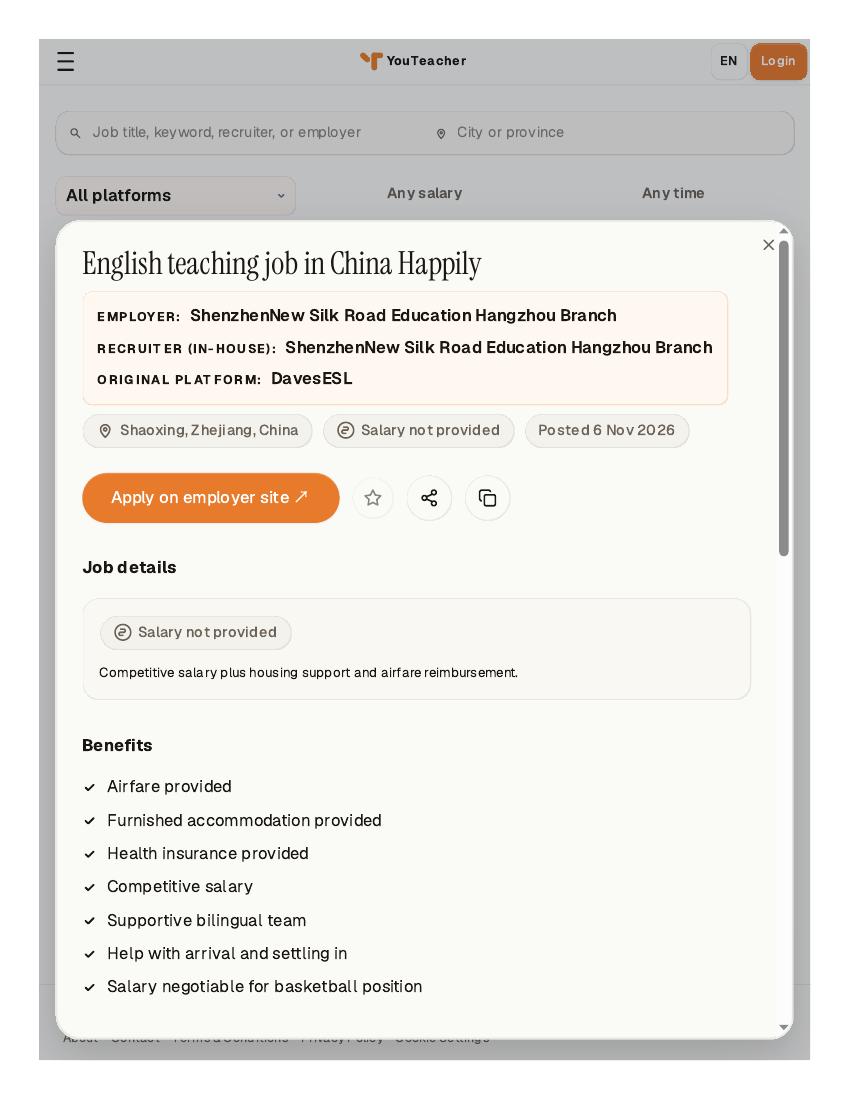
The monthly number is rarely the whole package — the extras can be worth ¥5,000–¥10,000 a month on their own.
Housing. Free school housing or a monthly allowance is standard at public schools, universities, and most kindergartens. In Shanghai, allowances around ¥3,500 (about $490) a month are common. If an offer has neither, add ¥2,000–¥4,000 a month to your costs.
Flights. Most contracts include one return flight a year, or a flight allowance. Check whether it's paid upfront, reimbursed after you arrive, or only paid when you finish the contract.
Health insurance. Schools are required to provide it, but the quality varies wildly. Ask what's covered and which hospitals you can use. If the answer is vague, read our guide to seeing a doctor in China so you know what a hospital visit actually costs.
Contract-completion bonus. Typically one month's salary, paid when you finish the contract. Some schools pay it monthly instead, or split it. Get the exact terms in writing.
Paid holidays. Public schools and universities give you the national holidays plus long summer and winter breaks. Training centres give you far fewer days off — that's part of why they pay more.
Meals and extras. Some kindergartens and schools include lunch, and some offer a Chinese-lesson subsidy. Small things, but they add up over a year.
Tax: What Comes Off
China taxes residents on a progressive scale: 3% on the first ¥36,000 (about $5,000) of annual taxable income, 10% up to ¥144,000 (about $20,000), and 20% up to ¥300,000 (about $41,700). Most first-year teachers land in the 3% or 10% brackets, so the effective rate on a typical salary is low — a few hundred RMB a month. Your school handles the withholding, but do check your first payslip: the tax line should be small, and anything that looks like a large "management fee" or "agency fee" deducted from your pay is worth questioning. And remember, your salary lands in a Chinese bank account — our guide to opening a bank account in China covers what to bring and which bank to pick.
One change to watch: some Jiangsu universities started paying salaries via digital yuan (e-CNY) wallets in November 2026, and foreign staff can't open those wallets yet — schools have transitional arrangements. Ask a university employer how the salary reaches your account.
A Real Month: What a First-Year Teacher Keeps
Take a first-year teacher at a public school in Chengdu on ¥16,000 a month (about $2,220), with housing provided:
Salary in: ¥16,000
Housing: provided, worth roughly ¥2,500 a month
Food: ¥2,000 — cooking some nights, eating out most nights
Transport: ¥300 — metro and the odd DiDi
Phone and internet: ¥100
Fun and social life: ¥1,500 — hotpot with friends, a weekend trip, a movie
Everything else: ¥500 — clothes, toiletries, the odd Taobao order
Tax: roughly ¥500
Left over: about ¥11,100 (about $1,540) a month
That's roughly ¥130,000 (about $18,000) saved over a twelve-month contract, before the completion bonus and the flight home. It matches what the guides report — most teachers save somewhere between $600 and $1,500 a month. The teachers who struggle are almost never the ones on low salaries. They're the ones who didn't check whether housing was included.
How to Read an Offer (and Spot a Bad One)
Check the full package in writing. Salary, housing, flights, insurance, bonus, holidays, and teaching hours should all be in the contract, in numbers, not in promises.
Count the teaching hours, not the office hours. Two offers at ¥20,000 are not the same if one is 16 teaching hours and the other is 25. Ask how many are actual classroom hours.
Ask who sponsors your visa. Only accept a job where the school sponsors your Z visa and work permit. Teaching on a tourist visa is illegal, and the fines land on you as well as the school. Our jobs pillar explains the visa path step by step.
Watch for the classic traps. A salary that looks too good for the hours, a "training fee" you have to pay upfront, a contract that lets the school change your campus or your hours without agreement, or a recruiter who won't put you in touch with a current foreign teacher at the school. Any one of these is a reason to walk away. Browse English teaching jobs in China and compare real offers side by side before you commit to one.
Confirm the probation terms. Some contracts pay less during a probation period or withhold the bonus if you leave early. Know the numbers before day one.
How to Negotiate Your Salary
You can negotiate, and most schools expect it. Here's what moves the number:
Experience and qualifications. A teaching licence, a CELTA, or two years of classroom experience are the three things that reliably push an offer up a band. A 120-hour TEFL is the baseline; it rarely moves the number on its own.
The city. If you're willing to go somewhere other than Beijing or Shanghai, say so — schools in Tier 2 cities compete harder for good teachers.
The extras, not just the salary. If the school won't move on the monthly number, ask for a higher housing allowance, a flight paid upfront, or the completion bonus paid in two halves. Schools often have more room on extras than on salary.
Timing. Schools hiring for the February or September start are under the most pressure, and that's when the best offers appear.
Pro Tips
Compare the package, not the salary. A ¥20,000 offer with free housing beats a ¥24,000 offer with nothing, in almost any city.
Save in RMB, send home in chunks. International transfers cost less per transfer when you send more at once — our guide to sending money home covers the cheapest routes.
Your first week sets your year. Walk into class with a plan, not a panic. If you want a no-prep lesson ready for day one, our own Closet Clash game (¥29, about $4) runs a whole class with zero preparation — it's the one we'd hand a new teacher first.
Keep a paper trail. Save your contract, every payslip, and every message about pay. If a dispute ever comes up, the teacher with the paperwork wins.
The Bottom Line
Teaching English in China pays well — well enough to live comfortably and save real money — but the salary on the offer letter is only the start of the story. The school type sets the range, the city sets the cost, and the package sets what you actually keep. Do the maths on the whole offer and ask the awkward questions before you sign — China rewards teachers who do their homework, and you've just done yours.
FAQ
How much do English teachers make in China in 2026?
Most first-year foreign English teachers earn ¥10,000–¥25,000 a month (about $1,400–$3,500), with housing on top. Licensed teachers at international schools can reach ¥25,000–¥45,000 (about $3,500–$6,250).
What type of school pays English teachers the most in China?
International schools — typically ¥25,000–¥45,000 a month — but they usually require a home-country teaching licence and classroom experience. Among entry-level jobs, kindergartens and bilingual schools pay the most, at ¥18,000–¥30,000 a month.
Do English teachers in China get free housing?
Usually, yes. Free school housing or a monthly housing allowance is standard at public schools, universities, and most kindergartens. In Tier 1 cities, allowances around ¥3,500 a month are common. Always confirm the exact arrangement in the contract.
How much can an English teacher save in China?
Most teachers save $600–$1,500 a month. A first-year teacher on ¥16,000 a month with housing provided can realistically save around ¥11,000 (about $1,540) a month, or roughly ¥130,000 over a year, before the completion bonus.
Do I have to pay tax on my teaching salary in China?
Yes. China taxes residents progressively: 3% on the first ¥36,000 of annual taxable income, 10% up to ¥144,000, and 20% up to ¥300,000. Most first-year teachers fall in the 3% or 10% brackets, and the school handles the withholding.
Photo: Paul The Writer, Wikimedia Commons (CC0).