How to Book High-Speed Train Tickets in China

How to Book High-Speed Train Tickets in China
The first time I took a high-speed train in China, I did everything wrong. I arrived ten minutes before departure, joined the wrong queue, and watched my train glide out of the station while I was still trying to figure out which gate was mine. The second time, I arrived early, walked straight through, and was eating noodles at 300 kilometres an hour while the countryside flew past the window. The difference between those two trips was about twenty minutes of preparation. This guide is that preparation.
Trains are how China moves. The high-speed network is the biggest in the world, the trains are clean and on time, and a trip that takes five hours by car takes ninety minutes by rail. Once you know how to book a ticket, you'll use the train for everything: weekend trips, holidays, visiting friends in other cities. Here's how it works.
The short answer: Book on the official 12306 app (铁路12306) with your passport. Tickets open 15 days before departure, and you pay with WeChat Pay or Alipay — the English version of 12306 also accepts foreign Visa and Mastercard. Second-class seats are cheap — a direct G-train from Shanghai Hongqiao to Hangzhou East is ¥73 (around $10). Slower D-trains on the same route run ¥47–¥65 second class (about $6.50–$9). Bring your passport to the station, arrive 30 to 45 minutes early, and your ticket is tied to your passport, so there's no paper ticket to lose.
Why Take the Train
Why you need it: China is huge, and flying between cities means airports, security queues, and delays. The train leaves from the city centre, arrives in the city centre, and runs on time almost every time. For any trip under five hours, the train beats the plane. It's also how your Chinese friends travel, so it's the fastest way to feel like you actually live here.
What's great about it: The trains are quiet, smooth, and fast — up to 350 kilometres an hour on the main lines. There's proper legroom, big windows, a dining car or trolley, and phone signal most of the way. And the price is honest: what you see is what you pay, no baggage fees, no seat-selection surcharges, no surprises at the gate.
What You Need Before You Book
Your passport. Your ticket is tied to your passport number, so the name on the booking must match your passport exactly. This is the same rule as the bank — get the name order right the first time.
The 12306 app (铁路12306, Tiělù 12306). This is the official railway app, and it's the only place to book at the real price. Third-party apps add fees. Download it from your phone's app store and set it to English if the option is there.
A Chinese phone number. The app sends verification codes by SMS. If you haven't sorted your phone yet, read my guide on getting a SIM card and phone setup in China first.
WeChat Pay or Alipay, linked to a Chinese bank card. That's how you pay in the app. If your WeChat is set up as your digital lifeline, you're already halfway there.
Teacher tip: Register on 12306 and verify your passport at least a day before you need a ticket. Verification sometimes takes a few hours, and you don't want to be doing it at 11 p.m. the night before a holiday weekend when every seat is selling out.
Booking on 12306, Step by Step
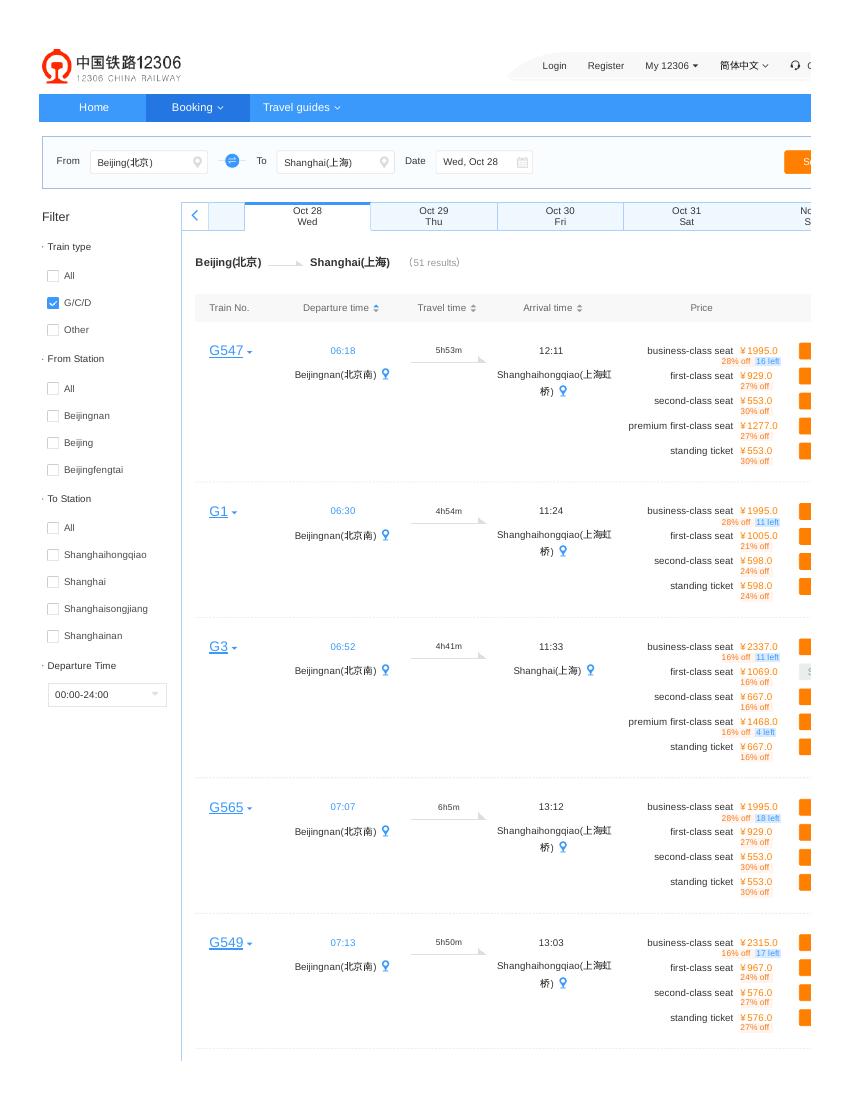
Open the 12306 app and log in. If it's your first time, register with your phone number, then add your passport under "Passengers" — full name exactly as on the passport, passport number, and date of birth.
Search for your trip. Enter your departure city, arrival city, and date. Tickets open 15 days ahead — each departure station has its own release time (often 8 a.m. Beijing time) — and popular routes sell out fast on holiday weekends.
Pick a train. You'll see G-trains (fastest, up to 350 km/h), D-trains (fast, up to 250 km/h), and slower trains. G-trains cost more and save the most time. For a short hop, a D-train is fine and cheaper.
Choose your seat. Second class (二等座, èr děng zuò) is the standard seat and perfectly comfortable. First class (一等座) is wider with fewer seats per row. Business class (商务座) is a lie-flat pod and costs several times more — fun once, not for every trip.
Pay. Choose WeChat Pay or Alipay, enter your payment password, and the ticket is booked. You'll get a confirmation in the app and by SMS. Screenshot it.
Check your ticket in the app. Under "My Tickets" you can see the train number, departure time, carriage, and seat. No paper ticket needed — your passport is your ticket.
At the Station
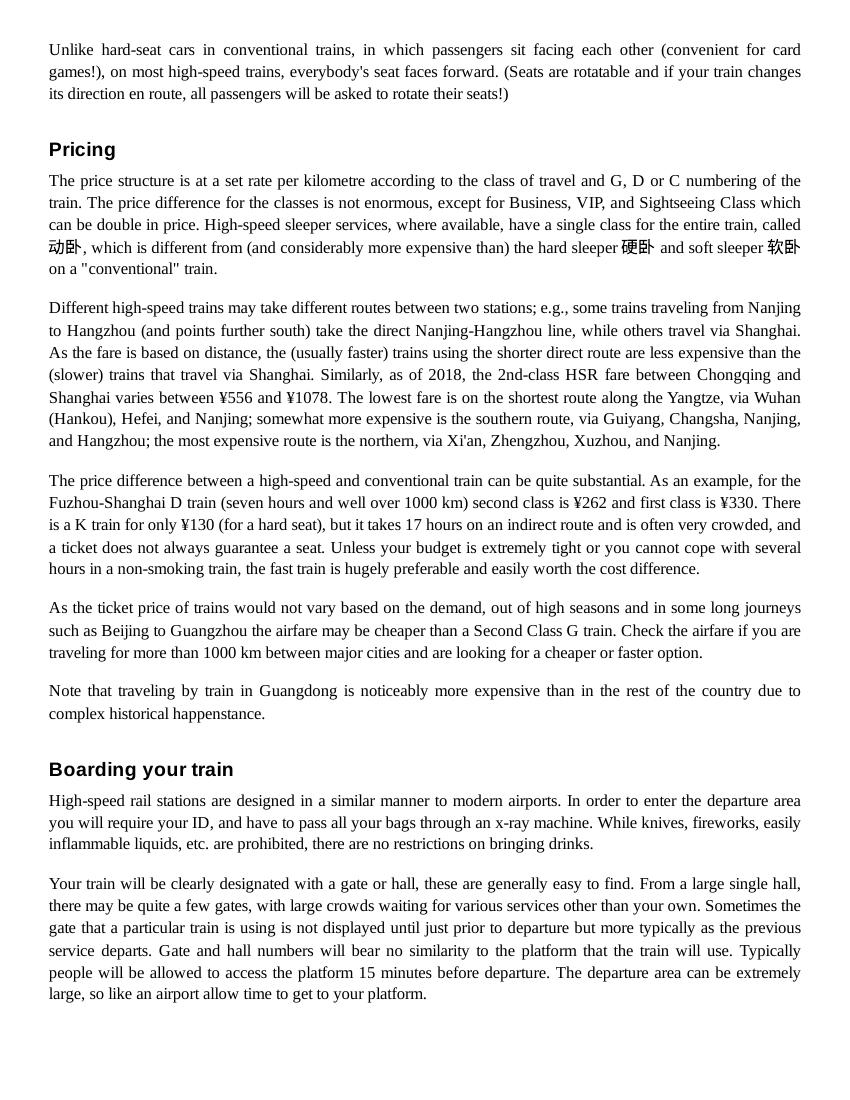
Chinese train stations are big, busy, and well signed in English. Here's the routine:
Arrive 30 to 45 minutes early. Security and ID checks take time, and stations are crowded on weekends.
Go through security. Bags on the belt, walk through the scanner, collect your bags. Same as an airport, but faster.
Check in with your passport. At the ticket gates, scan your passport (not a ticket) at the reader. The gate opens when it recognises your booking.
Find your gate. The departure board shows your train number and gate. Gates usually open 15 minutes before departure and close 3 minutes before. Don't be the person sprinting down the platform.
Board and find your seat. Carriage numbers are on the platform floor and on the train doors. Your seat number is in the app.
Teacher tip: The station name matters. Big cities have several stations — Shanghai has Shanghai, Shanghai Hongqiao, and Shanghai South, and they are not near each other. Check which station your train leaves from before you order your DiDi to get there.
On the Train
Luggage: There's overhead rack space and a luggage area at the end of each carriage. Big suitcases go there; keep valuables with you.
Food: There's a dining car on longer routes and a trolley that comes through with snacks, drinks, and instant noodles. Bringing your own food is completely normal — everyone does it.
Phone and wifi: There's onboard wifi, but it's slow. Download your shows before you board, and bring a power bank.
Tickets and checks: Staff sometimes check passports on board. Keep yours in your bag, not in your suitcase.
What It Costs: A Weekend in Hangzhou
Here's a real trip: Shanghai to Hangzhou for a Saturday, coming back Sunday. Prices from 12306 and my own spending, at about ¥7.20 to the dollar.
Train ticket, second class, direct G-train, each way: ¥73 (about $10)
Metro to Shanghai Hongqiao station: ¥4 (about $0.55)
Lunch on the train, noodles and a drink: ¥30 (about $4.15)
Metro from Hangzhou East to West Lake: ¥4 (about $0.55)
Round trip total for transport and food: about ¥184, or roughly $25.50. A flight for the same trip would cost three times as much before you even count the taxi to the airport. For longer routes the gap narrows, but for anything under three hours, the train wins on price and on time. The ticket price above is the published G-train benchmark fare for Shanghai Hongqiao–Hangzhou East; the metro and food prices are from my own trips.
Pro Tips
Book the moment tickets open. For Friday evenings and holiday weekends, tickets open 15 days ahead. Check your station's release time in the app and set an alarm. The good departure times go first.
Sit on the correct side. On scenic routes, the window side matters. It changes by direction and train, so ask a colleague who has done the route — or just enjoy whichever side you get.
Bring snacks and water. Station food is fine, but it's twice the price of the shop outside. Stock up before you go in.
Keep your passport handy, not packed. You need it at the gate, at security, and sometimes on board. Put it in your jacket pocket, not at the bottom of your bag.
If you travel often, save your regular routes. The app lets you save frequent trips, which turns booking into a thirty-second job.
Troubleshooting
The train I want is sold out. Try a different departure time, or a slower D-train on the same route. Tickets also get released again when other people cancel, so check the app a few times — especially the evening before travel.
My name doesn't match my passport. This is the most common booking error. Delete the passenger from the app and add them again, family name first, exactly as on the passport. If the ticket is already booked with the wrong name, refund it and rebook — don't try to board with it.
I missed my train. Go to the ticket counter with your passport. You can usually change to a later train on the same day for a small fee, or refund the ticket minus a handling charge. Don't just buy a new ticket before asking — the change is cheaper.
I need a refund. Refund in the app under "My Tickets" before departure for the smallest fee. After departure, you have to do it at the station counter. Refunds go back to the payment account you used, usually within a few days.
The app is in Chinese and I can't read it. The English option is in the settings, but it's incomplete. The key buttons are the same every time: search, select, pay. After two bookings you'll do it by memory. A screenshot and a translation app will get you through the first one.
You've Got This
Booking a train ticket in a foreign language sounds intimidating, and my first attempt ended with me watching my train leave without me. But it's a skill you learn exactly once. Download the app, verify your passport today, book one short trip this weekend, and by the second trip you'll be doing it in your sleep. China is a big country, and the train is how you see it — cheap, fast, and honest. Get out there and use it.
FAQ
Can foreigners book train tickets on 12306?
Yes. Register with your Chinese phone number, add your passport as a passenger, and you can book exactly like a local. Your passport is your ticket at the gate.
How far in advance can I book?
Tickets open 15 days before departure. For holiday weekends, book the moment they open — the popular trains sell out within hours.
Do I need a paper ticket?
No. Your booking is tied to your passport. Scan your passport at the station gate and board. Keep the app confirmation as a backup.
What's the difference between G-trains and D-trains?
G-trains are the fastest (up to 350 km/h) and cost more. D-trains are fast (up to 250 km/h) and cheaper. For trips under two hours, the difference is often just a few minutes.
Can I change or refund a ticket?
Yes. Change or refund in the app before departure for the smallest fee. After departure, go to the station ticket counter with your passport. Refunds return to your payment account within a few days.
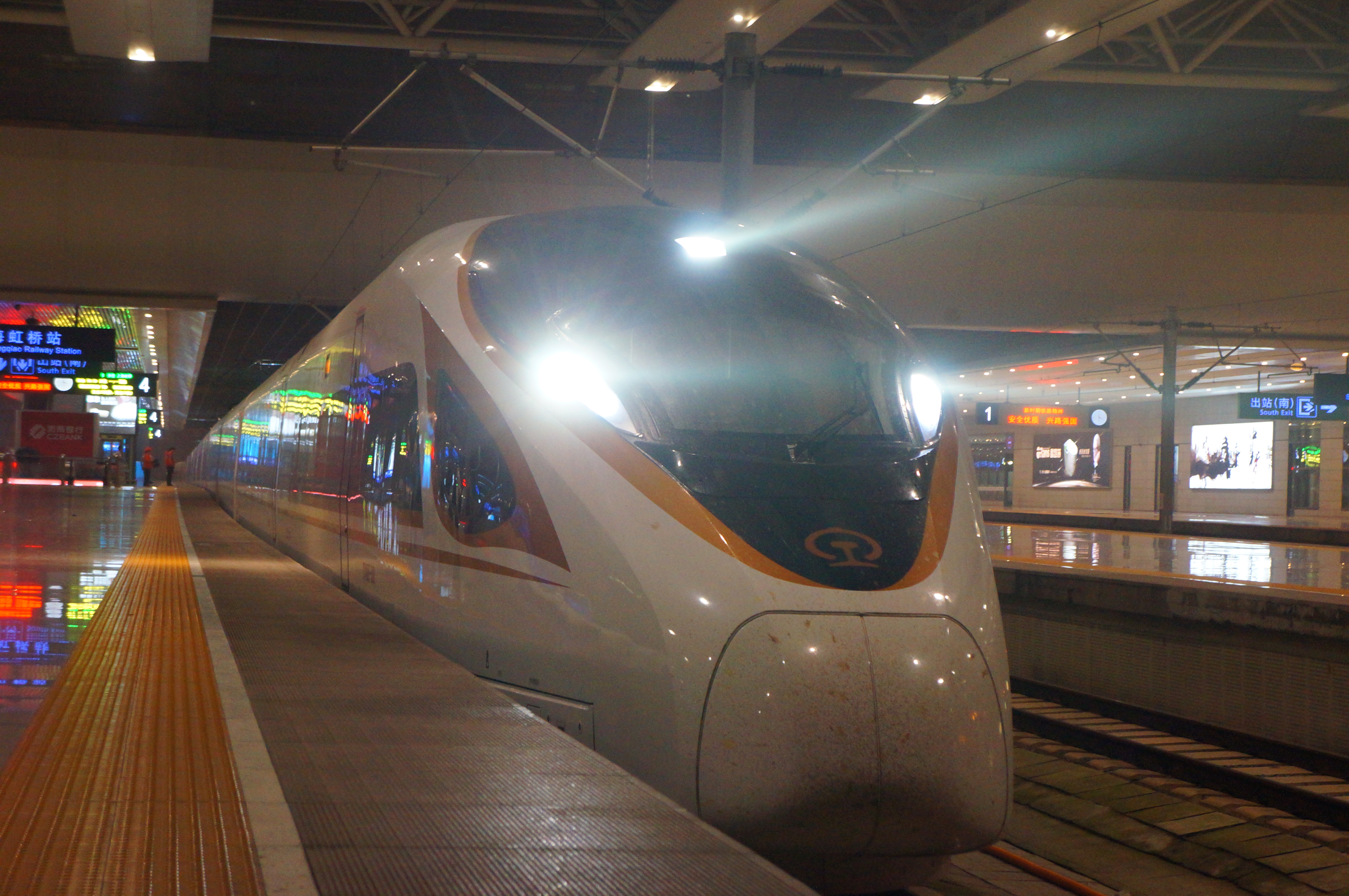
Hero photo: Fuxing G155 entering Shanghai Hongqiao Station. Photo by MNXANL, via Wikimedia Commons, CC BY-SA 4.0.